STUDY OF OPPOSITES
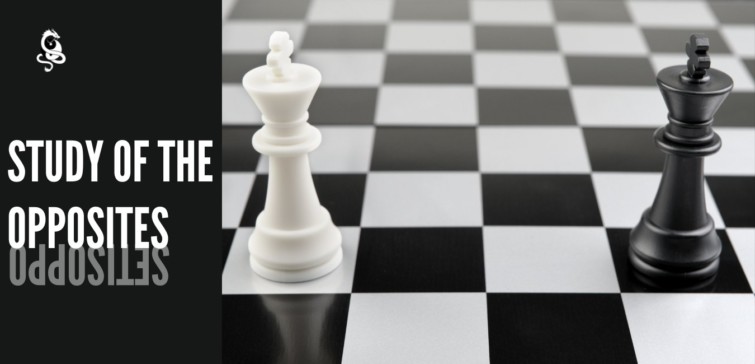
Does every opposite represent an extreme? And what to do with this information?
Western thinking has the habit of looking at opposites in a simple way: of course versus dark, warm versus cold, masculine versus female and so on.
But the orientals have a different way of looking at and dealing with these opposites. Besides considering them as extremes, using them as excellent points of reference, they have the understanding that opposites are complementary.
Black is the opposite of "snow white" or "ice white"? Can something have more than a single opposite? Wouldn't it be more correct to simply say that white is lighter than black and that it is completing the image on this page that you are reading now?
Ancient oriental sages studied this reality and realized that there are extremes, but also a range of intermediates. They reflected on the extremes and intermediate using them as reference points and concluded that their existence influences our daily lives.
They realized that nature adapts to these variations and concluded that men should do the same, that is, act in a way that is appropriate to the moment being experienced.
The study of the I Ching is done to learn (or remember) how to act in the right way in each situation (Middle Philosophy or Middle Way), just like Nature.
The problem is not to act in an extreme way if situation demand. What we should avoid is acting only in one way when faced with different situations. Acting in a single way shows a person either attached or lacking in wisdom (or both!).
The I Ching is a guide to show the Middle Way. As expected, it uses the extremes and the in-between for this aim.
LINK RELACIONADO
 English
 Português do Brasil
 Español
 Français